
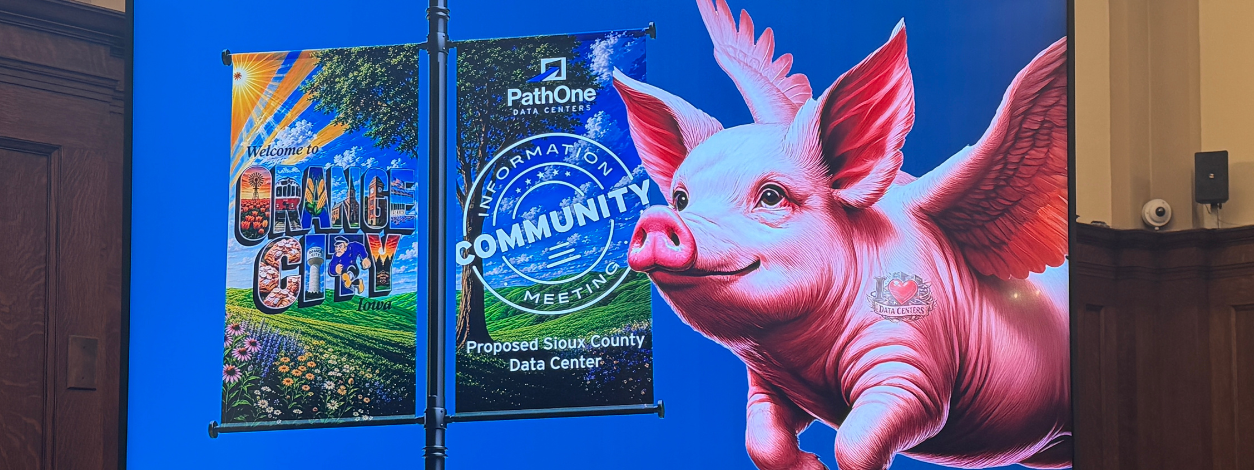
ORANGE CITY, Iowa — A proposed data center southwest of Hull was the focus of a community informational meeting Monday evening, August 10, at the Sioux County Courthouse in Orange City, where representatives of PathOne Data Centers presented additional details about the project and answered questions from area residents.
The presentation addressed several of the issues that have surrounded the proposal, including electricity demand, water use, noise, construction investment, employment, taxes and the size of the proposed development.
The meeting comes as Sioux County continues to evaluate how data centers should fit into the county’s long-term development plans.
Proposed Site Southwest of Hull
The project is being considered for property at 3071 330th Street, Hull, Iowa, approximately two miles southwest of Hull.
The property is the former Bison Renewable Energy site and already contains infrastructure that developers say makes it attractive for data center development.
During Monday night’s presentation, PathOne also invited members of the public to visit the proposed site to see where the project could be built and how it would fit into the surrounding area.
According to a presentation slide, site visits are scheduled for:
- Wednesday, August 12: 3:00–6:00 p.m.
- Thursday, August 13: 3:00–6:00 p.m.
- Friday, August 14: 10:00 a.m.–2:00 p.m.
Representatives of PathOne Data Centers and Sunstone Investments had previously presented the concept to the Sioux County Board of Supervisors in late June. According to a report published by KTIV in June, 2026, the developers confirmed a buyer was in place before Sioux County moratorium.
PathOne Presents a Smaller Data Center Model
One of the major themes of Monday’s presentation was PathOne’s effort to distinguish its proposed development from the much larger hyperscale data centers that have generated attention elsewhere.
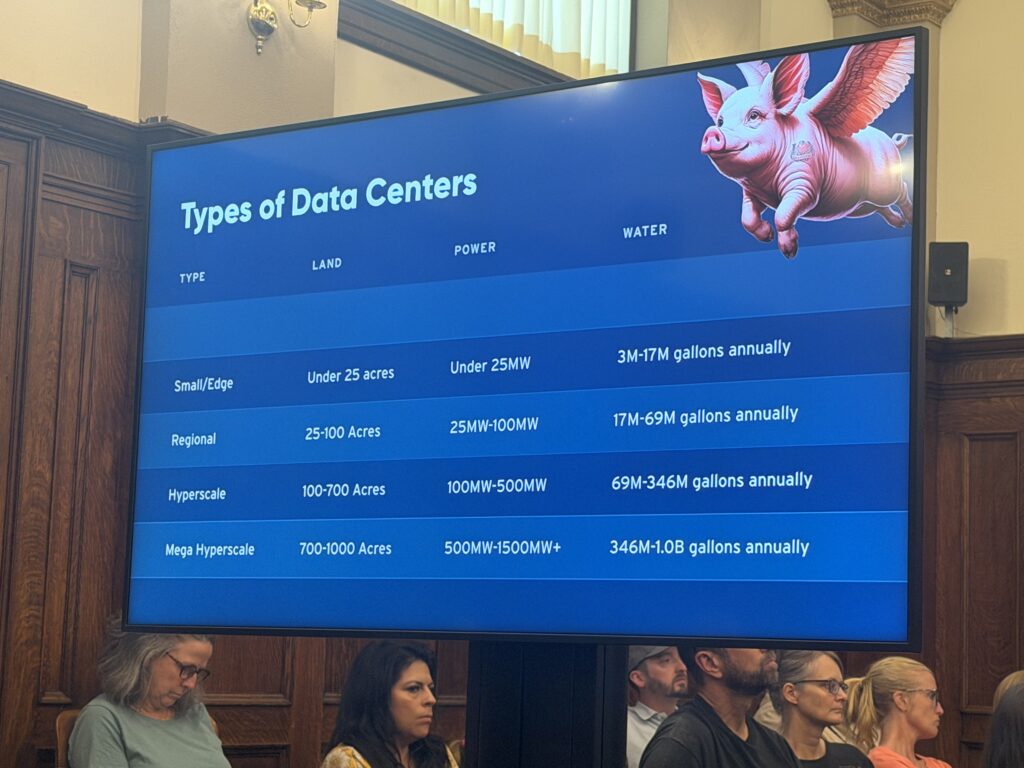
A slide comparing different types of data centers placed the PathOne model below small or edge, regional, hyperscale and mega-hyperscale facilities in terms of land, power and water requirements.
PathOne’s presentation described its model as using less than 25 acres, with development occurring in approximately 10-megawatt increments.
By comparison, the presentation characterized regional data centers as requiring 25 to 100 acres and 25 to 100 megawatts of power, while hyperscale projects could require 100 to 700 acres and 100 to 500 megawatts.
Mega-hyperscale developments were shown as potentially reaching 700 to 1,000 acres and using 500 to more than 1,500 megawatts.
The comparison was clearly intended to communicate that the Hull-area proposal would operate on a considerably smaller scale than the massive data center campuses that have driven many national discussions about artificial intelligence infrastructure.
10 MW and 25 MW Scenarios Presented
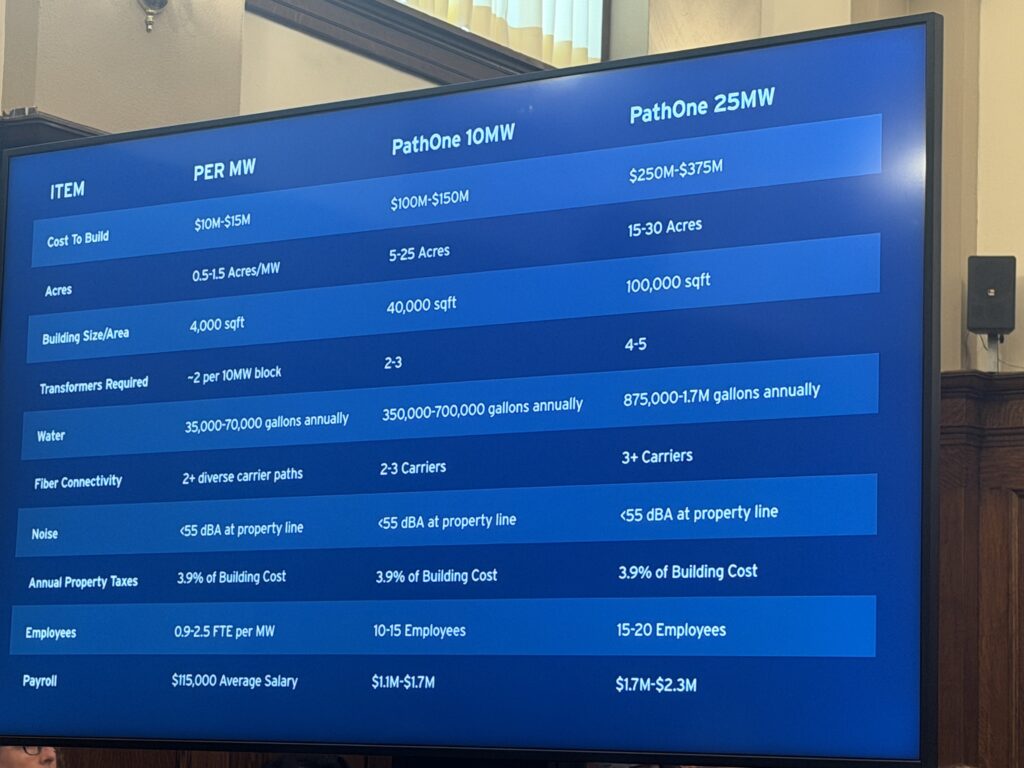
PathOne presented estimates for both 10-megawatt and 25-megawatt data center configurations.
For a 10 MW facility, PathOne estimated:
- Construction cost: $100 million to $150 million
- Land requirement: 5 to 25 acres
- Building size: Approximately 40,000 square feet
- Transformers: Two to three
- Water use: Approximately 350,000 to 700,000 gallons annually
- Fiber connectivity: Two to three carriers
- Noise: Less than 55 dBA at the property line
- Employees: Approximately 10 to 15
- Estimated payroll: $1.1 million to $1.7 million annually
For a 25 MW configuration, the presentation estimated:
- Construction cost: $250 million to $375 million
- Land requirement: 15 to 30 acres
- Building size: Approximately 100,000 square feet
- Transformers: Four to five
- Water use: Approximately 875,000 to 1.7 million gallons annually
- Fiber connectivity: Three or more carriers
- Noise: Less than 55 dBA at the property line
- Employees: Approximately 15 to 20
- Estimated payroll: $1.7 million to $2.3 million annually
Those figures were provided by PathOne as part of its presentation and should be viewed as developer projections rather than finalized operating figures for an approved project.
Water Use Receives Particular Attention
Water consumption has become one of the most closely watched issues surrounding data center development, particularly as some large artificial intelligence facilities elsewhere in the country have been associated with significant cooling-water requirements.
PathOne used its presentation to argue that its proposed model would use substantially less water.
The company’s comparison placed PathOne’s annual water use at approximately 340,000 to 700,000 gallons for its smaller model.
The same presentation estimated annual consumption of:
- 3 million to 17 million gallons for small or edge data centers
- 17 million to 69 million gallons for regional data centers
- 69 million to 346 million gallons for hyperscale facilities
- 346 million to 1 billion gallons for mega-hyperscale developments
Another PathOne slide estimated approximately 350,000 to 700,000 gallons of annual water use for a 10 MW development and 875,000 to 1.7 million gallons for a 25 MW project.
The difference between those projections illustrates why the eventual size and configuration of the Hull-area facility will be important when evaluating its potential resource requirements.
PathOne Compares Project to a Movie Theater
In one of the presentation’s more unusual comparisons, PathOne placed a hypothetical 10 MW data center alongside a movie theater to illustrate how the company views the project’s community impact.
According to PathOne’s slide, a 10 MW facility would cost between $100 million and $150 million to build, compared with approximately $10 million to $25 million for the example movie theater.
The company estimated that its 10 MW facility would occupy roughly 40,000 square feet — similar to the 40,000-to-70,000-square-foot range used in the movie theater comparison — but would have significantly higher electrical demand.
PathOne estimated the data center’s annual water use at 350,000 to 700,000 gallons, compared with approximately 2 million gallons for the movie theater example.
Traffic was described as low and predictable at the data center, compared with potentially hundreds of customer visits each week at a theater.
PathOne also projected noise below 55 decibels at the property line, which its presentation characterized as comparable to a movie theater.
The company estimated 15 to 22 full-time employees and approximately $2.53 million in annual payroll in this particular comparison.
It is worth noting that employment figures differed somewhat between slides in the presentation. Another slide estimated approximately 10 to 15 employees for a 10 MW facility and 15 to 20 employees for a 25 MW facility. Those differences may reflect different assumptions or project configurations.
Property Taxes Could Become a Significant Part of the Discussion
PathOne’s presentation repeatedly referenced an estimated annual property-tax figure equivalent to 3.9% of building cost.
If applied directly to the company’s estimated construction values, that could represent a substantial tax contribution.
However, the actual taxable value, tax treatment, potential incentives, exemptions and distribution of property-tax revenue would depend on the project’s final structure and applicable Iowa and local tax rules.
For that reason, the 3.9% figure should be viewed as a number presented by the developer rather than a guaranteed amount of future Sioux County revenue.
Tax implications are likely to remain an important part of the county’s evaluation, particularly when weighed against electrical demand, infrastructure requirements and the number of permanent jobs created.
Power Demand Remains a Central Question
PathOne’s presentation provided greater clarity about the scale of electrical demand developers are contemplating.
A 10 MW development would require approximately 10 megawatts of electrical capacity, while the larger configuration presented would require approximately 25 megawatts.
PathOne also indicated that approximately two transformers would generally be required for each 10 MW block of development.
Electrical availability is one of the reasons developers have identified the former Bison Renewable Energy property as a potential data center location.
For county officials and residents, the broader question will be how the proposed demand could affect electrical infrastructure, future capacity and other customers in the region.
Noise Projections Below 55 dBA at Property Line
Noise has also been raised as a concern with data center projects because cooling systems, generators and other equipment can operate continuously.
PathOne’s presentation projected noise levels of less than 55 dBA at the property line for both the 10 MW and 25 MW configurations shown.
Whether that standard would become an enforceable requirement, and how noise would be measured or monitored if the project moves forward, will likely be among the details considered as Sioux County evaluates potential regulations.
Sioux County Currently Has a Moratorium
The proposed Hull-area project is being discussed while a one-year Sioux County moratorium on new data centers and battery energy storage systems remains in effect in the county’s unincorporated areas.
County officials approved the temporary pause in June to give supervisors and planning officials additional time to study the industry and determine what regulations may be appropriate before applications are considered.
Supervisor Craig Hoftyzer said when the moratorium was adopted that county leaders wanted more information about potential effects involving property, water, electricity and the environment before establishing long-term policy. He also stressed that the moratorium did not amount to a permanent rejection of data centers.
The moratorium applies to unincorporated Sioux County and does not prevent incorporated cities from making their own land-use decisions within city limits.
Developers Have Said an End User Is Interested
One of the more significant details disclosed during the project’s earlier presentation to county supervisors was that developers said an end user had already been identified before the county’s moratorium went into effect.
Jesse Rognes of Sunstone Investments told supervisors in June that the project had an end user ready to move forward and acknowledged that the timing of the moratorium complicated the development process.
The identity of that potential end user has not been publicly disclosed in the sources reviewed by Lewis Marketing.
Monday’s presentation provided considerably more detail about the physical and economic characteristics of a potential project, but questions remain about exactly which configuration would ultimately be constructed and who would operate the facility.
Economic Impact Versus Resource Demand
Monday night’s presentation sharpened one of the central questions facing Sioux County: What would the community receive in exchange for hosting a data center, and what resources would the facility require?
PathOne’s estimates point to a project involving potentially hundreds of millions of dollars in construction investment, more than a dozen permanent jobs, annual payroll potentially exceeding $2 million, and significant taxable property.
At the same time, even a relatively small data center would represent a large concentrated electrical load and would operate continuously.
Those competing considerations — economic development on one side and infrastructure, resource and land-use concerns on the other — are at the heart of the county’s current review.
Lewis Marketing attended the August 10 informational meeting at the Sioux County Courthouse in Orange City and photographed portions of PathOne Data Centers’ presentation.